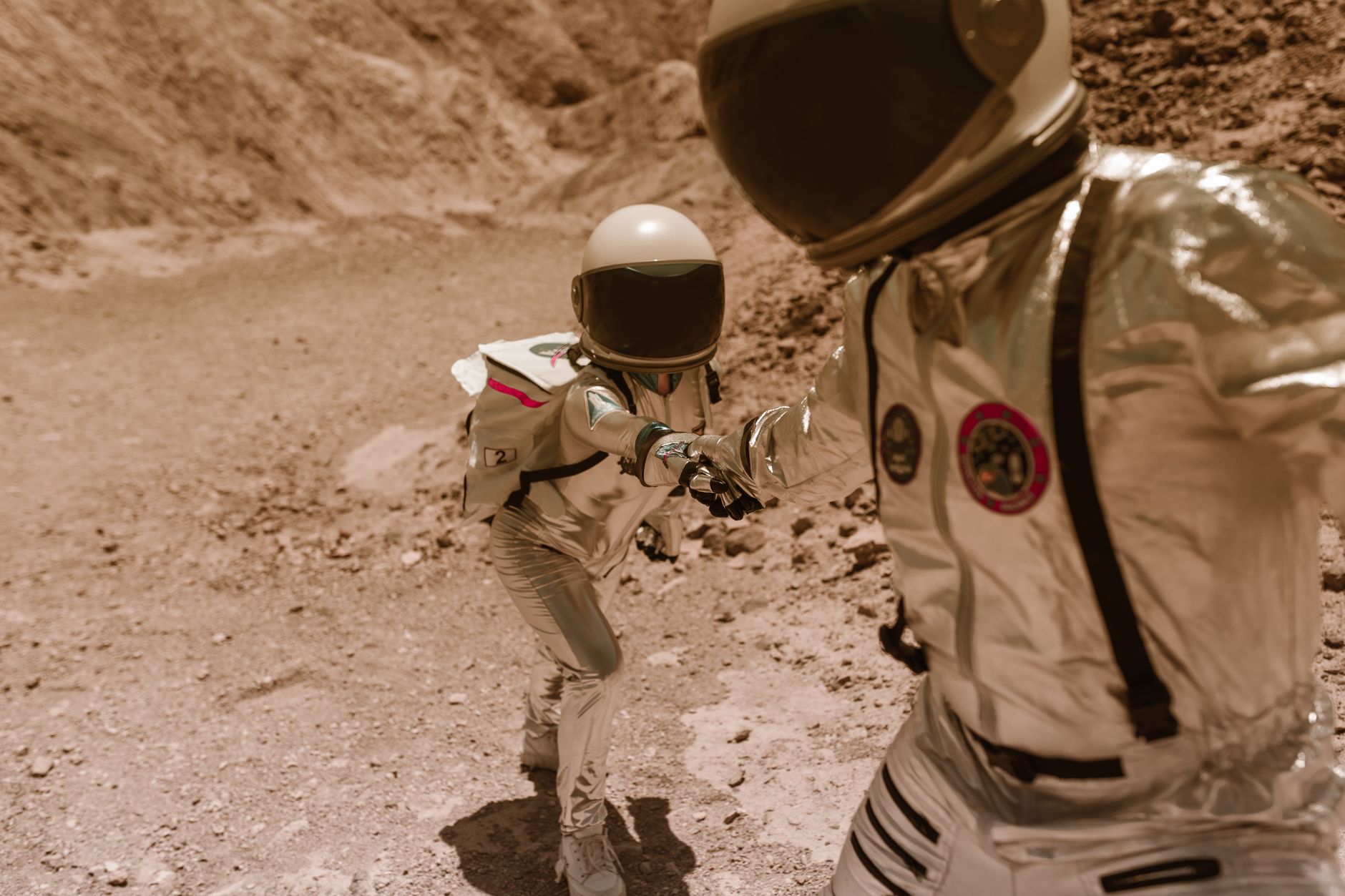
A spacecraft can reach its destination and still fail as a place for people to live. On a short mission, a cramped bunk, repetitive meals or equipment noise may be tolerable. Over months or years, the same conditions can affect sleep, attention, mood and cooperation. The central challenge of human factors in space missions is not simply keeping a crew alive. It is creating an environment in which people can remain capable, healthy and themselves.
Habitability is therefore an engineering requirement, not a decorative extra. A long-duration spacecraft must support ordinary human functions—sleeping, eating, concentrating, exercising, relaxing, disagreeing and repairing relationships—under extraordinary constraints. Microgravity or partial gravity, radiation, limited volume, restricted supplies, communication delays and the absence of familiar natural surroundings all change the design brief.
The most important improvements may not look spectacular. They may be better lighting, quieter fans, a door or curtain that can be closed, a familiar meal or a place where one person can be alone without being unreachable. Such details can influence whether an isolated habitat feels merely survivable or genuinely livable.
Why long missions change the design brief
Short missions can treat discomfort as a temporary cost. Long-duration spaceflight cannot. When a stressor is repeated every day, its effects can accumulate. A poorly timed alarm can interrupt sleep; disrupted sleep can make attention more difficult; reduced attention can make routine work more error-prone. A lack of privacy can make minor disagreements harder to escape, while repetitive food can become a source of dissatisfaction.
These pressures interact. Confinement limits the ability to change one’s surroundings. Microgravity changes how people move, work and use equipment. Radiation creates risks that cannot be solved by personal discipline alone. On missions far from Earth, communication delays would limit the usefulness of immediate advice from mission control. Supplies, power, water and interior volume would also be limited, so every feature would compete with scientific equipment, propulsion and life-support systems.
Designers can draw lessons from submarines, Antarctic stations, remote field camps, hospitals and other isolated and confined environments. These settings offer evidence about routines, group dynamics, noise, privacy and monotony. They are analogies, not replicas: a submarine has gravity, and an Antarctic station does not reproduce the hazards of spaceflight. The value of comparison is in identifying principles while recognizing where space imposes different demands.
Sleep: designing for a body without familiar cues
Sleep is a biological need that becomes a systems problem in space. On Earth, the light-dark cycle, regular social schedules, temperature changes and the feeling of gravity help organize daily life. In orbit, frequent sunrises and sunsets, artificial lighting, shift work, exercise, alarms and vehicle operations can compete for attention. In a deep-space habitat, the crew may instead follow an artificial schedule that has to be maintained deliberately.
Supporting astronaut sleep and circadian rhythms involves more than assigning a bedtime. Lighting can be scheduled to support alertness during work and a gradual transition toward rest. Sleeping compartments can limit unwanted noise and light. Temperature and airflow can be managed for comfort, while work planning can reduce unnecessary interruptions. Exercise and medical activities also need to fit around recovery rather than treating sleep as leftover time.
Sleep affects attention, learning, emotional regulation and decision-making. Fatigue is therefore not merely a comfort issue. In a complex habitat, a tired crew member may have more difficulty diagnosing a malfunction, following a procedure or interpreting a colleague’s behavior accurately. The consequences of an error will depend on the task and mission, but a long-duration habitat has little reason to make recovery harder than necessary.
Private sleeping quarters are valuable even when space is scarce. A small compartment with controllable light, personal storage and some acoustic separation can give the body and mind a consistent signal that work has ended. It can also reduce the social pressure of sleeping in a shared room. The goal is not to recreate a hotel bedroom. It is to provide enough control and predictability for recovery.
Privacy: the small territory each person needs
Privacy in a spacecraft is physical and psychological. It includes the ability to close off a sleeping area, change clothes, read, think or simply be out of view. Acoustic privacy matters too: a person may be technically alone but still unable to escape conversations, machinery or other people’s routines.
Limited volume creates a difficult trade-off. Partitions, doors and private compartments add mass, occupy space and may complicate emergency access or maintenance. A habitat also needs appropriate monitoring for safety and health. Privacy cannot mean complete isolation, and every boundary must work with emergency procedures.
Flexible measures can create different degrees of separation without using all available volume. Curtains, sliding panels, directional lighting, personal audio, scheduled quiet periods and private communication channels are possible examples. A retreat space might be shared by schedule rather than assigned permanently. Storage can help define personal territory, reducing the sense that every object belongs to everyone.
The reason this matters is cumulative stress. Without opportunities to withdraw, ordinary irritations remain present all the time. The same conversation, movement or sound that would be harmless on Earth can become exhausting when there is nowhere else to go. Privacy in spacecraft is not a luxury reserved for comfortable missions; it gives people some control over their exposure to one another.
Food: nutrition, memory and morale in one system
Food must meet several requirements at once. It has to be safe to store, practical to prepare, compatible with the vehicle’s environment and nutritionally adequate. In microgravity, loose crumbs and droplets can interfere with equipment or hygiene, while limited water, refrigeration and cooking capacity restrict what can be served. Packaging and waste management are part of the meal system as well.
Nutrition is only one part of eating. Taste and smell can be experienced differently in space, and familiar foods may not always feel the same in orbit. A menu that meets nutritional targets can still become monotonous if its textures, aromas and flavors offer little variation. Menu fatigue may make eating less appealing when the same supplies must last for a long mission.
Food in space also carries memory and identity. A preferred snack, familiar spice or dish associated with home can provide continuity when almost everything else is unfamiliar. Shared meals create a natural pause in the workday. A birthday, holiday or mission milestone can be marked with a special preparation even when ingredients are constrained.
This does not mean every meal should be a celebration. Routine is useful, and a crew needs reliable options for busy or difficult days. The design challenge is to offer choice within limits: different textures, flavors and preparation methods, along with opportunities for communal or private eating. Nutritional adequacy supports the body; satisfying food can also support morale, social connection and a sense of normal life.
Conflict: designing for repair rather than permanent harmony
Conflict is normal in any group. In space, fatigue, confinement, workload, cultural differences and uncertainty can make disagreements more intense or harder to escape. A tense exchange may continue to shape the atmosphere of a habitat after the original issue has been resolved.
Crew selection and interpersonal training are important, but they cannot replace environmental design. No selection process can guarantee permanent harmony, and no team-building exercise eliminates stress. A resilient habitat helps people recover. That may require spaces for private conversations, places to decompress, communication with psychological support teams and schedules that prevent work from consuming every waking hour.
Clear roles can reduce ambiguity during routine operations, while shared decision-making can give crew members a legitimate voice in matters that affect daily life. Procedures should also allow roles to change when circumstances require it. A rigid hierarchy may be useful during an emergency but less suitable for a group that must live together over an extended period.
Sound, circulation and visibility can affect social friction. A single shared workspace may force constant interaction, while a quiet area can create distance without making someone unavailable. Private communication with family or support staff may help a crew member process stress before it becomes a group problem. The goal is not permanent agreement. It is the capacity to disagree, pause and repair.
Boredom and cognitive variety: the problem of too little change
Space missions are demanding because of danger and technical complexity, but they can also be difficult because daily life is repetitive. The same walls, procedures, equipment and companions may be present for weeks or months. Repetition can reduce motivation and make attention harder to sustain, especially when the surrounding environment offers little visible change.
Boredom is not simply a desire for entertainment. It can affect alertness, mood and the perceived meaning of work. A crew that cannot vary its activities may find it harder to stay engaged with routine tasks. In safety-critical settings, reduced attention matters even when nobody feels seriously distressed.
Habitats can provide variety through exercise, music, books, films, games, creative projects, external views and meaningful scientific or maintenance work. Interfaces can present information clearly without filling every surface with alerts. Interior layouts can distinguish work, rest and recreation zones, even when those zones overlap physically.
Novelty must be balanced against cognitive overload. A constantly changing interface or an abundance of entertainment can become another demand on attention. The more durable principle is choice: the ability to select a quiet activity, a social activity, a physical activity or a meaningful task according to one’s condition that day. Behavioral health in space depends partly on having something worthwhile to do and some control over how to do it.
Social rituals: making a machine feel like a place to live
Rituals help people mark time. On Earth, meals, weekends, religious observances, birthdays and seasonal events provide structure beyond individual tasks. In an isolated habitat, those signals can weaken. A shared routine can restore some continuity.
A ritual might be a regular group meal, a weekly briefing followed by informal conversation, a private tradition between crewmates or a celebration of a mission milestone. It does not need to be elaborate. Repetition is part of its value: people know when it will happen, what it means and how they can participate.
Shared practices can strengthen group identity, but they should not become compulsory performances. Crew members differ in culture, religion, personality and energy. Good design leaves room for communal life and individual choice. A habitat might provide a common dining area while allowing someone to eat privately, or establish a regular gathering without requiring everyone to socialize in the same way.
Allowing crews to shape some of their own rituals is also important. If every minute is prescribed from Earth, the habitat may feel like a workplace without ownership. Choosing a meal, organizing a film night or deciding how to mark an occasion gives crew members a limited but meaningful role in shaping daily life.
What spacecraft can learn from other isolated habitats
Submarines, Antarctic research stations, remote medical facilities, undersea habitats and field camps have all explored aspects of isolation and confinement. Their lessons commonly point toward predictable schedules, meaningful activity, good ventilation, manageable noise, private communication, personal territory and opportunities to experience natural patterns or views.
These environments also show the value of distinguishing work from recovery. When the same room serves as office, dining area and bedroom, the mind receives fewer cues that a task has ended. Even modest visual or lighting changes can help define transitions. Clean air, appropriate temperature and control of unwanted sound are similarly easy to underestimate because they are often unnoticed when they work well.
Analogy has limits. A remote station on Earth may be resupplied or evacuated more easily than a spacecraft, and communication delays may be shorter. Space habitats must also account for launch constraints, microgravity or partial gravity, radiation and life-support failure modes. A design principle can transfer while its implementation changes.
The useful question is not whether a spacecraft should copy a submarine or polar station. It is which human need those habitats reveal, and how that need can be met under spaceflight constraints.
Designing for the whole crew, not an abstract average person
There is no single standard crew member. People differ in body size, sleep timing, sensory sensitivity, food preferences, cultural expectations, social energy and responses to stress. A habitat designed around an average person may be inconvenient or unsafe for many of its users.
Inclusive design is therefore a mission-resilience issue. Adjustable lighting, adaptable work surfaces, accessible storage, flexible sleeping arrangements and interfaces that support different sensory needs can help a crew respond to changing conditions. Someone recovering from illness, injury or poor sleep may need a different arrangement from the one that worked at the start of the mission.
Modularity can support that flexibility. Movable equipment, reconfigurable partitions and personal settings allow a habitat to change as the crew changes. The cost is added complexity, mass or maintenance, so not every feature can be adjustable. The design process should nevertheless ask whose needs are being assumed and what happens when those assumptions prove wrong.
Individual differences matter socially as well. Some people recover by talking; others need solitude. Some prefer predictable meals; others seek variety. Some sleep easily in unfamiliar places; others need strict environmental control. Strong space habitat design does not eliminate these differences. It gives the crew practical options for managing them.
The wider lesson: isolated habitats on Earth
The same principles apply beyond space. Climate shelters, disaster-response facilities, remote clinics, underwater research sites and future off-world settlements all require people to function where resources, privacy and connection are limited. The solutions may differ, but the questions are shared: Can people sleep? Can they control their exposure to others? Can they eat well enough to sustain morale? Can they withdraw, reconnect and find meaningful activity?
Space research makes these questions unusually visible because every kilogram, watt and cubic metre must be justified. It shows that a habitat is not just a container for technology. It is an arrangement of cues, boundaries, routines and relationships. Ventilation, acoustics and lighting can influence behavior as surely as a communication system or life-support pump.
Long missions will require advanced propulsion, radiation protection and reliable life support. Technical capability alone, however, will not make a distant habitat successful. The crew must be able to recover from poor sleep, tolerate necessary confinement, preserve personal dignity, manage conflict and maintain a sense of purpose.
The most livable spacecraft will not be the one that removes every difficulty. It will be the one that gives people practical ways to rest, relate, adapt and remain themselves while the mission continues.
That is the quiet science of habitability. It treats comfort as connected to safety, privacy as connected to cooperation, food as connected to identity and ritual as connected to time. Designing for humans in space means designing for the ordinary acts that allow people to endure extraordinary places.
Image by RDNE Stock project on Pexels.