A robot does not become understandable because it has a warm voice, says “please,” or appears to make eye contact. Those features can make an encounter feel easier, but they can also create a dangerous shortcut: people may infer competence, care or certainty that the machine does not possess.
The central challenge of human robot interaction is not making robots seem more human. It is making them legible. People need to know what a robot has noticed, what it is about to do, what it cannot do, when it is uncertain and how they can stop, correct or ignore it. A friendly voice can support that goal. It cannot replace it.
This matters because robots are increasingly leaving controlled demonstrations and entering spaces governed by ordinary human expectations: homes, hospitals, warehouses, schools, shops, streets and shared workplaces. In those environments, communication is rarely just a matter of spoken instructions. It is conveyed through movement, timing, distance, posture, lights, pauses, prompts and the reliable opportunity to say no.
Good human-robot communication should help people cooperate with a machine without misleading them about what the machine is, knows or intends. The best designs do not demand blind faith. They make appropriate trust possible.
The problem with making robots sound friendly
Giving a robot a polite voice is an understandable design instinct. Speech is familiar, and conversational language can reduce the friction of operating a new system. A delivery robot that says it is waiting for a door to open may be easier to use than one that simply stops. A hospital robot that gives clear instructions may reduce confusion for staff and patients.
But friendliness and intelligibility are not the same thing. A reassuring tone can obscure uncertainty. Human-like phrasing can imply a level of understanding that an automated system does not have. A robot that says, “I understand,” may only have matched a phrase to a preconfigured command. One that says, “I’m sorry,” may be following a social script rather than recognizing harm or taking responsibility.
The risk is not that robots use language. The risk is that language becomes theatrical: an interface that smooths over gaps between what users reasonably assume and what the system can actually do. This is especially consequential when a robot makes recommendations, handles personal data, moves near people or participates in care, education or work.
Human-centered robotics begins with a less glamorous question than “How do we make this robot lovable?” It asks: What must a person understand in order to make an informed choice about cooperating with this machine?
In most cases, the answer includes four things: the robot’s current state, what it is attending to, what it plans to do next and the boundaries of its capability. A robot should not merely announce its presence. It should make its operational reality observable.
Communication begins before a robot speaks
People read motion socially. They notice whether something turns toward them, approaches quickly, hesitates at a doorway, occupies a narrow corridor or moves directly into their path. Even a plainly mechanical machine can be interpreted as attentive, impatient, cautious or intrusive because humans are accustomed to drawing meaning from spatial behavior.
That makes physical behavior a core part of robot behavior design. A robot’s orientation can indicate whom it is serving. Its movement path can indicate whether it intends to pass, stop or yield. A visible status light may distinguish “idle” from “recording,” “waiting” from “navigating,” or “needs assistance” from “ready to proceed.” Distance can signal respect for personal space.
These cues are often more useful than elaborate facial expressions. If a mobile robot is about to turn across a pedestrian’s route, a slight pause, a directional orientation and a clear movement preview may communicate more than an animated face ever could. If a collaborative workplace robot needs a person to move away from a work area, it should use signals that make the relevant space and action clear, rather than relying on a generic cheerful warning.
Useful robot gestures are functional. They should answer practical questions: Where is the robot going? What object or area is relevant? Has a task finished? Is the robot yielding? Does it need help? Decorative gestures, by contrast, can consume attention without improving comprehension.
Consistency matters as much as expressiveness. A signal used for “I am about to move” should not sometimes mean “I am scanning” or “I am pleased.” People can learn a modest vocabulary of cues when the rules remain stable. They struggle when the same motion is presented as personality one moment and instruction the next.
Movement is a promise about what happens next
In physical environments, movement is not simply output. It is a promise. When a robot angles its body, highlights a route or pauses before moving, people may reasonably prepare for what follows. If the robot repeatedly violates those expectations, trust erodes quickly.
For this reason, predictable motion can be more socially valuable than human-like motion. A robot does not need to walk, nod or gesture like a person. It needs to avoid surprising people. Its speed, stopping distance, turning behavior and response to nearby bodies should be understandable enough for others to safely share space with it.
What gestures can tell us—and what they cannot
Gestures are valuable when they transmit operational information. A robot can point toward a collection point, indicate an obstacle, show where it intends to travel, signal that it has completed a delivery or physically orient toward the person whose turn it is. In a busy environment, these nonverbal cues can be more accessible than speech alone.
Yet gestures also carry social baggage. A lowered head, sympathetic posture or a hand placed over a chest may be read as remorse, concern or emotional understanding. A robot may be designed to mimic such expressions, but it does not follow that it experiences the feelings those signals conventionally represent.
This distinction is especially important in social robotics. A companion device may be intended to encourage conversation or routine. An educational robot may be meant to make a lesson engaging. A care-related device may be designed to reduce loneliness or prompt an activity. In each case, emotional cues can influence behavior. That influence should be treated as a design responsibility, not as harmless charm.
Children, older adults, people in distress and people who have limited experience with automated systems may be particularly likely to interpret social signals literally or form expectations that exceed the robot’s real abilities. Designers should be cautious about cues that imply empathy, confidentiality, authority or a reciprocal relationship. The more vulnerable the setting, the greater the need for clear boundaries.
A robot can acknowledge a user’s situation without pretending to possess human understanding of it.
For example, a system can say that it cannot complete a request and offer contact with a staff member. It need not imply sadness, personal concern or a promise it cannot keep. Respectful communication is not cold communication. It is communication that does not ask users to mistake a designed response for a human relationship.
Timing is part of the message
Timing changes meaning. A long silence after a command can look like failure. An immediate answer to a difficult question can look like certainty. An interruption can make a robot appear inattentive; an overlong confirmation sequence can make it feel obstructive. In human-robot communication, pauses and response speed are part of the interface.
A robot that needs time to interpret a request, plan a route or check a safety condition should communicate that it is doing so. This does not require a detailed technical account. A brief indication that it is processing, checking a route or waiting for an obstruction to clear can help people distinguish delay from malfunction.
Likewise, a robot should not rush to produce an answer merely because rapid conversation feels natural. Fast, fluent language may encourage users to assume the system has verified information or fully understood a request. When a robot is working from uncertain input, ambiguity should be visible in a form users can act on: a request to confirm, a statement that it may have misunderstood, or a clear option to repeat or choose another route.
Turn-taking deserves similar care. In a crowded reception area, a robot should make it clear whether it is listening to one person, waiting for another or unavailable while completing a task. In a home, it should offer a way to cancel or interrupt a sequence. In a workplace, it should not create pressure to respond at the pace the machine prefers.
Context matters. A navigation robot may need to react quickly to a person entering its path, while a teaching robot may need longer pauses so a learner can think. But adaptation should not become erratic. A system can vary its pace while preserving recognizable rules about when it listens, moves, waits and asks for confirmation.
Transparency means explaining behavior at the right moment
Robot transparency is often misunderstood as an obligation to expose every technical detail. Most people do not need a stream of sensor readings, model parameters or internal logs to decide whether to step aside, correct an error or decline a request. More information is not automatically more understanding.
Practical transparency means providing the information needed for the decision at hand. Before a consequential action, people should be able to understand what the robot plans to do, what information it is using, what its relevant limits are and what alternatives remain available.
That can take simple forms:
- A mobile robot previews that it will cross a corridor or enter a room.
- A care-related system states whether it is giving a reminder, collecting information or contacting staff.
- A workplace machine indicates that it has detected an unexpected condition and is shifting into a slower or safer mode.
- A service robot explains why it cannot perform a request instead of repeating a generic refusal.
- A system that records audio, video or location data makes that sensing visible and explains how a person can seek help or opt out where appropriate.
Uncertainty belongs in this picture. Explainable robots should not make every internal probability visible, but they should avoid presenting tentative judgments as settled facts. When the system cannot identify an object, cannot safely navigate a space or cannot interpret a request, the honest response is to say so and provide a recovery path.
Transparency is most useful before an error becomes costly. A post-incident explanation may help accountability, but it does little for a person who had no warning that the robot was about to act. Action previews, clear escalation to a human and visible stop mechanisms are forms of transparency because they preserve the user’s ability to intervene.
Predictability is not the same as simplicity
People can learn to work with complex systems. They do it with cars, software, medical devices and industrial equipment. What makes a system manageable is not necessarily simplicity; it is the ability to form reliable expectations and recover when something goes wrong.
For robots, predictable behavior includes stable rules for movement, personal space, requests, confirmations, handovers and emergency stops. It includes a clear distinction between ordinary operation and an unusual safety state. It also includes communication when normal patterns change.
A robot may need to act differently because a room has become crowded, a route is blocked, a new task has been assigned or a safety condition has been detected. The change itself may be justified. What undermines trust is the unexplained shift. If the machine normally yields at a doorway but suddenly proceeds, people need a cue that its operating conditions have changed.
This is one reason constant personality redesign can be a problem. A new voice, mood or interaction style may seem minor to a product team, but it can make a familiar system harder to read. In a setting where people depend on routine, a plainly mechanical but consistent interface may be safer than a charming one that regularly changes its social performance.
Recoverability is equally important. Users need ways to correct a misunderstanding, undo a request, pause a task, summon human assistance or disengage. A robot that handles errors with calm, clear options will usually be more trustworthy than one that tries to conceal uncertainty behind conversational polish.
The ethics of being understood without being manipulated
Communication supports informed cooperation when it helps a person understand options and consequences. It becomes manipulative when it exploits social instincts to push compliance.
Robots can be unusually persuasive because they occupy physical space and may use gaze, voice, urgency, praise or apparent vulnerability. A robot that repeatedly says it is disappointed, acts lonely when switched off or uses a childlike manner to resist a user’s decision may be doing more than communicating. It may be applying emotional pressure.
There are comparable risks when robots imply authority or competence they do not have. A uniform-like appearance, confident language or a commanding tone may cause people to defer even when the system is only making a limited recommendation. This dynamic resembles a broader problem in automated decision-making: people can over-rely on systems that appear more capable or certain than they are.
Ethical human-robot interaction therefore requires boundaries. Robots should not claim feelings, expertise, relationships or responsibility they cannot possess. They should not make refusal difficult through guilt or urgency. They should provide meaningful user control, including the ability to pause, decline, seek clarification and contact a human decision-maker when the context warrants it.
Workers deserve particular attention. A robot deployed in a warehouse, shop or factory can affect pace, monitoring and job autonomy. Communication should make it clear what the robot is doing and what data it is collecting, rather than turning surveillance or workflow pressure into an invisible background condition. The right to question or contest a system’s output should not disappear because an instruction arrives in a pleasant voice.
Designing a shared language between people and machines
A useful design framework for human-centered robotics is straightforward: signal intent, make uncertainty visible, preserve turn-taking, use consistent cues, provide recovery paths and respect attention.
Each principle reinforces the others. Spoken instructions should match visible movement. A status light should not indicate availability while the robot is ignoring commands. A robot that says it will yield should physically create space. A request for confirmation should allow enough time for an answer and offer a clear way to cancel.
Multimodal communication can improve accessibility when it provides genuine alternatives rather than redundant decoration. A visual movement cue can assist a person who cannot hear speech. An audible notification can assist someone who cannot see a light. Plain language, understandable icons, adjustable volume, captions, tactile controls and reachable emergency stops can make a system more usable for people with different sensory, cognitive and mobility-related needs.
Designers should also avoid assuming that one set of social cues is universal. Expectations around eye contact, gesture, personal distance, politeness and authority vary across cultures and individuals. A robot should not treat one narrow model of “normal” interaction as the default for everyone.
Testing must extend beyond polished demonstrations. A robot that appears intuitive in a quiet laboratory may behave very differently in a noisy ward, a crowded station, a dim warehouse or a home where people are distracted, tired or caring for children. Real-world observation reveals interruptions, accessibility barriers, awkward handovers and misunderstandings that scripted trials can miss.
Questions every robot team should ask
- Can a nearby person tell what the robot is doing and where it will move next?
- Does the robot show uncertainty or ask for confirmation when it lacks enough information?
- Do its voice, lights, gestures and movement communicate the same message?
- Can a user interrupt, correct, refuse or safely disengage?
- Does the design imply emotions, authority or understanding beyond the machine’s actual capability?
- Have the cues been tested with diverse users in realistic conditions?
Where clearer communication matters most
The stakes of communication vary by setting. A confusing domestic assistant may waste time, frustrate a household or collect data in ways users did not anticipate. A confusing industrial or medical robot can create more serious risks by altering movement around people, delaying a handover or encouraging inappropriate reliance.
In homes, robots need to make sensing and data practices clear, particularly when cameras or microphones are involved. In hospitals and care settings, they should distinguish logistical support from clinical judgment and provide visible routes to human staff. In schools, they should avoid using artificial social closeness to substitute for teacher oversight.
In warehouses and factories, predictability is central to physical safety and coordinated work. People should be able to tell whether a robot is approaching, stopping, carrying a load or entering an abnormal condition. In public environments, robots must cope with crowds, varied accessibility needs and people who have never encountered the system before. Clear cues matter more than training manuals that nobody has read.
Autonomous vehicles and delivery machines highlight the same principle at a larger scale: other people need to understand what an automated system is likely to do. The solution will not always be a voice or a screen. Often it will be a combination of behavior, lighting, path choice and conservative interaction around uncertainty.
The future of human-robot interaction should feel clear, not magical
The most successful robot interface may not be the one that feels most like talking to another person. It may be the one that makes people feel informed, unpressured and able to act.
That is a higher standard than charm. It asks designers to treat speech, gesture, movement and apparent emotion as consequential signals rather than cosmetic features. It asks organizations to disclose meaningful limits, sensing and escalation paths. And it asks users to be given something more valuable than reassurance: a real understanding of what the machine can do.
Trust in robots should be earned through observable competence, honest limits and consistent behavior. A robot does not need to perform humanity to be useful. It needs to help people understand what is happening—and leave them with meaningful control over what happens next.
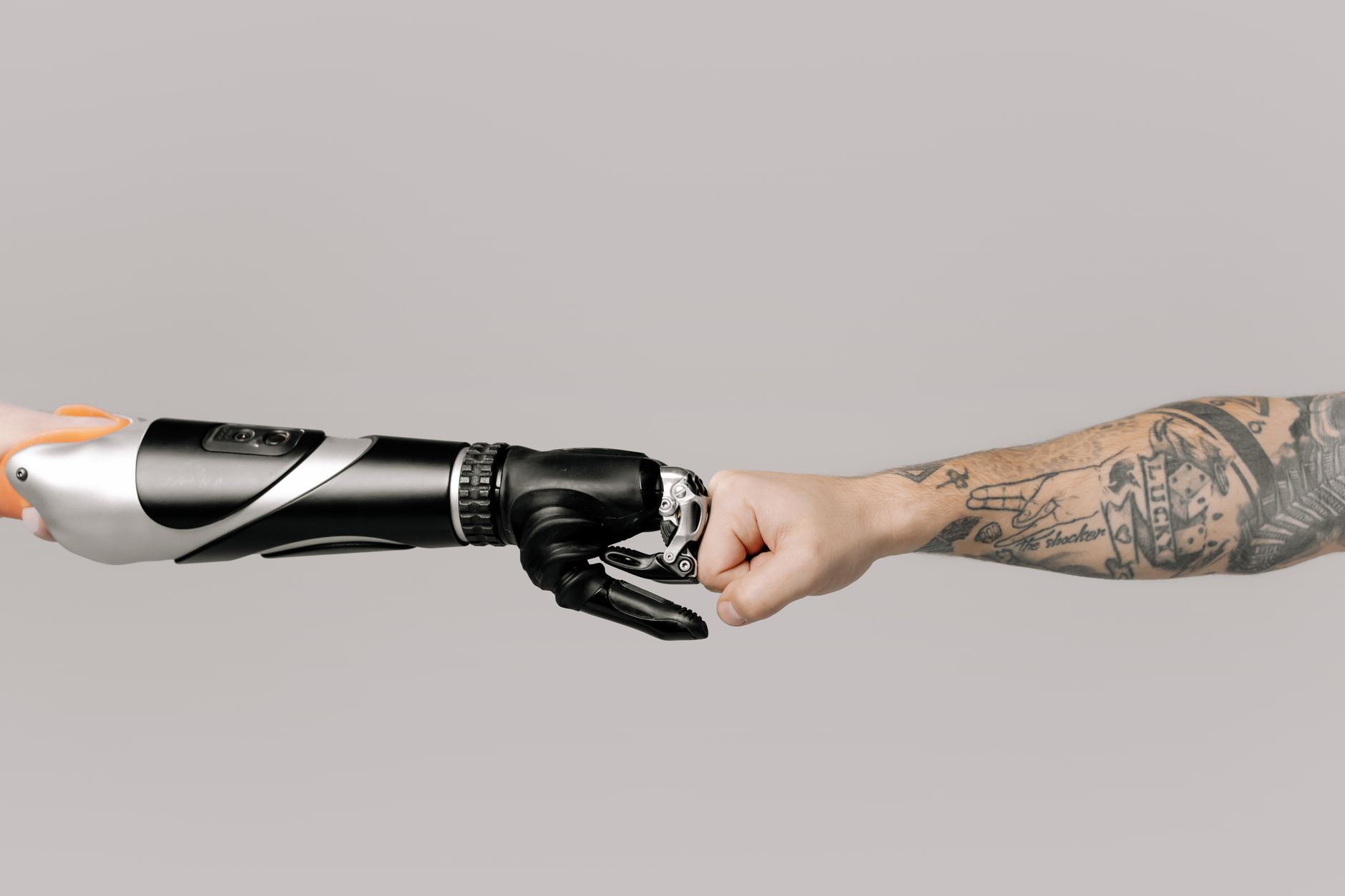
Image by cottonbro studio on Pexels.